

Steel thickness in Gauteng manufacturing is not just a detail. It is a fundamental requirement for everything from safety to quality control. Most people know there are different standards, but few realise that even a 0.01mm difference in thickness can change an entire project’s outcome. You might think reading a simple chart is enough, but measurement systems can trip up even experts. Knowing these conversions does not just save time, it prevents costly mistakes that could put your whole project at risk.
Table of Contents
- Understanding Steel Thickness Standards
- How To Read A Steel Thickness Conversion Chart
- Steel Gauge, Millimetres And Inches Explained
- Choosing The Right Steel Thickness For Your Project
Quick Summary
| Takeaway | Explanation |
|---|---|
| Understand steel thickness standards | Steel thickness standards ensure precision and safety in manufacturing and construction, vital for project reliability. |
| Be aware of measurement systems | Multiple measurement systems exist, such as metric and imperial; knowing them helps prevent conversion errors. |
| Follow systematic conversion methods | Accurately read conversion charts by locating measurements and cross-referencing between systems to avoid discrepancies. |
| Select appropriate thickness for applications | Consider factors like structural load, environmental conditions, and industry standards for optimal material performance. |
| Utilize advanced tools for efficiency | Employ computational modeling technologies for precise thickness calculations, enhancing project accuracy and efficiency. |
Understanding Steel Thickness Standards
Steel thickness standards represent a critical foundation for industrial precision and safety in manufacturing and construction. These standards provide a comprehensive framework that ensures consistency, quality, and reliability across different steel products and applications.
Global and Regional Steel Thickness Measurement Systems
Industrial professionals must navigate multiple measurement systems when working with steel thickness. The standard steel sheet dimensions guide for Gauteng industries highlights the complexity of these measurements. Internationally, measurement systems vary significantly between metric and imperial standards, creating potential challenges for engineers and fabricators.
According to ASTM International, steel thickness standards are meticulously defined to ensure precise manufacturing tolerances. These standards cover various aspects including:
- Dimensional Accuracy: Precise measurements for different steel product types
- Material Composition: Chemical and mechanical property specifications
- Manufacturing Tolerances: Acceptable variations in thickness and width
Technical Considerations in Steel Thickness Measurement
Measuring steel thickness requires sophisticated tools and understanding of industry-specific requirements. The American Institute of Steel Construction emphasizes that thickness measurements impact structural integrity, material performance, and overall project reliability.
Research from the AISC Steel Construction Manual indicates that steel thickness standards involve complex calculations considering:
- Material grade specifications
- Intended industrial application
- Environmental and stress conditions
- Mechanical load requirements
Professionals must understand that steel thickness is not a one-size-fits-all specification. Different industrial sectors require unique thickness standards tailored to specific engineering demands. Mining, construction, and manufacturing sectors each have distinct requirements that influence steel thickness selection and measurement protocols.
Understanding these nuanced standards requires continuous learning and staying updated with the latest international measurement guidelines. Precision in steel thickness measurement ensures structural reliability, prevents potential failures, and maintains high-quality manufacturing processes across various industrial applications.
How to Read a Steel Thickness Conversion Chart
Reading a steel thickness conversion chart requires precision and understanding of multiple measurement systems. These charts serve as critical tools for industrial professionals to accurately translate steel thickness across different standards and specifications.
Understanding Measurement Conversion Fundamentals
A steel thickness conversion chart is not merely a simple table but a complex reference instrument that bridges various measurement systems. According to the Engineering Toolbox, converting steel thickness involves understanding multiple variables including gauge numbers, imperial measurements, and metric dimensions.
Professionals must recognize key conversion principles:
- Imperial to Metric Translation: Converting inches to millimeters with exact precision
- Gauge Number Interpretation: Understanding how gauge numbers correlate with actual thickness
- Material-Specific Variations: Recognizing that conversion standards might differ slightly between steel grades
Practical Steps for Accurate Conversion
Reading a steel thickness conversion chart effectively requires a systematic approach. Industrial engineers and fabricators must develop a methodical technique to ensure accurate measurements. Learn more about precision steel grade identification to complement your thickness conversion skills.
Key steps in reading a conversion chart include:
The following table breaks down the practical step-by-step process recommended for accurately reading and converting steel thickness measurements, as outlined in the article.
| Step | Action | Purpose |
|---|---|---|
| 1 | Identify current measurement system | To determine if input is imperial or metric |
| 2 | Locate corresponding chart column | Find your original measurement in the chart |
| 3 | Cross-reference with desired system | Convert to the required output measurement system |
| 4 | Verify with multiple reference points | Ensure the conversion is accurate and consistent |
| 5 | Double-check calculations for critical use | Avoid costly errors in high-stakes applications |
- Identify the current measurement system (imperial or metric)
- Locate the corresponding column matching your original measurement
- Cross-reference with the desired output measurement system
- Verify the conversion using multiple reference points
- Double-check calculations for critical industrial applications
Typical conversion challenges arise from slight variations between standards. For instance, a steel sheet measured at 0.1875 inches might translate to approximately 4.76 millimeters, but precision instruments demand exact conversions.
Industrial professionals must remain vigilant about potential rounding errors. Small discrepancies in thickness measurements can significantly impact structural integrity, manufacturing processes, and overall project specifications. Utilizing standardized conversion charts from reputable sources ensures consistent and reliable measurements across different industrial contexts.
Mastering steel thickness conversion charts requires continuous practice, attention to detail, and a comprehensive understanding of international measurement standards. Engineers and fabricators who develop expertise in these conversion techniques can enhance their professional capabilities and deliver more precise industrial solutions.
Steel Gauge, Millimetres and Inches Explained
Steel measurement systems represent a complex landscape of technical precision, where gauge numbers, millimetres, and inches intersect to provide critical information for industrial applications. Understanding these measurement standards is fundamental for engineers, fabricators, and procurement specialists working with steel materials.
Understanding Measurement Systems
The steel industry utilizes multiple measurement systems that can often confuse professionals. Learn more about our standard steel sheet specifications to gain deeper insights into these technical nuances.
Gauge measurement is particularly intricate. Interestingly, gauge numbers work inversely to actual thickness: as the gauge number increases, the material thickness decreases. For instance, a 10-gauge steel sheet is significantly thicker than a 20-gauge sheet. This counterintuitive relationship requires careful attention and precise understanding.
Conversion Principles and Practical Applications
Converting between measurement systems demands mathematical precision. According to The Engineering Toolbox, standard conversion principles include:
- Gauge to Inches: Calculating exact thickness measurements
- Millimetre Equivalents: Translating imperial measurements to metric standards
- Material-Specific Variations: Recognizing differences across steel grades
Industrial professionals must understand that different sectors prioritize specific measurement standards. Construction projects might prefer imperial measurements, while international manufacturing often relies on metric systems. Mining and heavy industrial applications require meticulous conversion accuracy to ensure structural integrity and operational safety.
A typical conversion example illustrates the complexity: a 16-gauge steel sheet approximately equates to 0.0625 inches or 1.59 millimetres. However, slight variations can occur depending on specific manufacturing standards and material compositions.
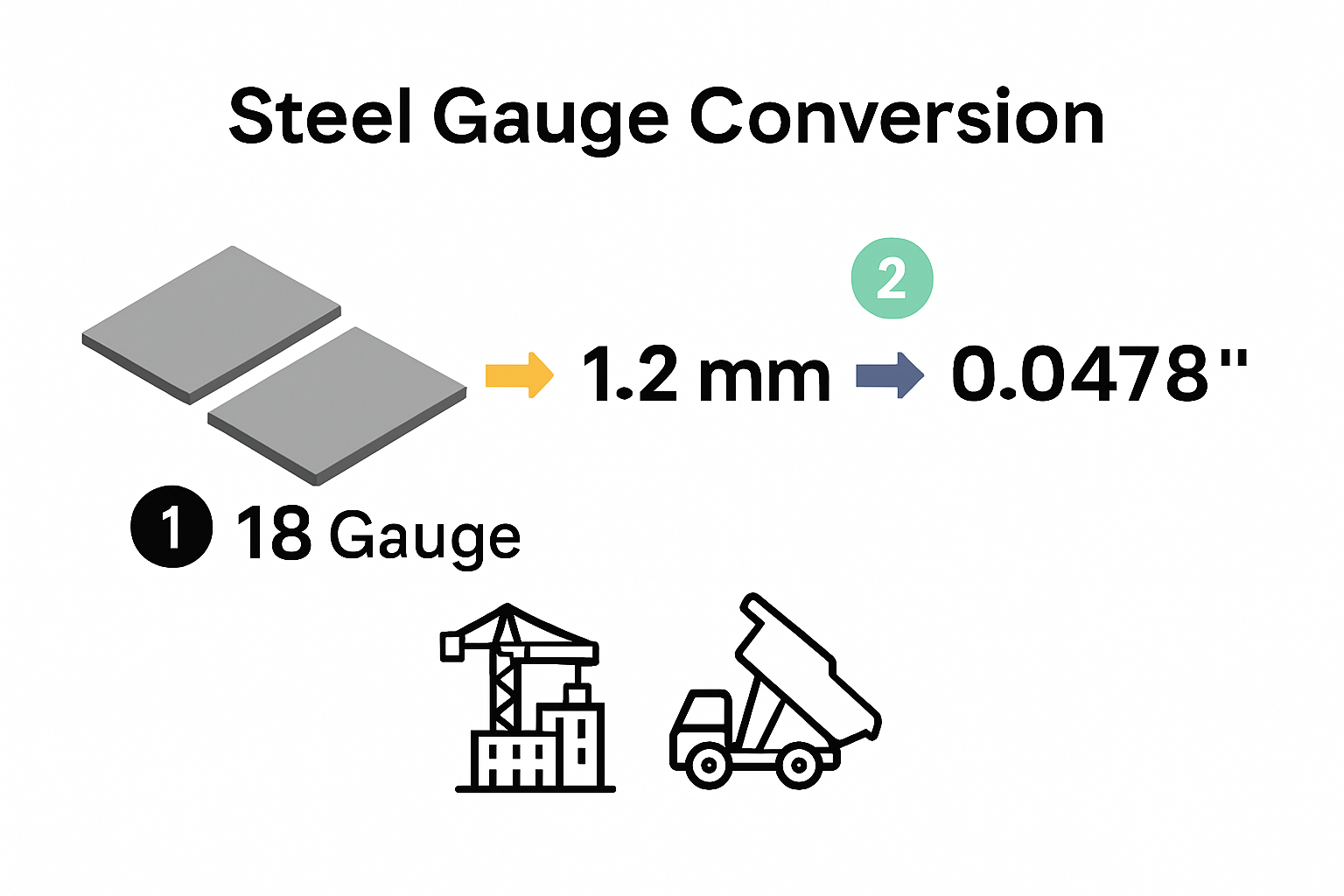
Precision in steel thickness measurement extends beyond simple numerical conversion. Engineers must consider factors like material grade, intended application, and environmental conditions. These variables significantly influence the selection and interpretation of thickness measurements.
Mastering these measurement systems requires continuous learning and practical experience. Professionals who develop comprehensive understanding of gauge, inches, and millimetre conversions can navigate complex industrial requirements with confidence and expertise. Attention to detail and a systematic approach remain crucial in interpreting and applying these technical standards effectively.
Choosing the Right Steel Thickness for Your Project
Selecting the appropriate steel thickness is a critical decision that directly impacts the structural integrity, performance, and longevity of industrial projects. Engineers and project managers must carefully evaluate multiple factors to ensure optimal material selection and performance.
Critical Factors in Steel Thickness Selection
Comparing steel plate and sheet specifications reveals the nuanced considerations involved in thickness selection. According to the National Institute of Standards and Technology, several key parameters influence steel thickness determination:
- Structural Load Requirements: Calculating anticipated mechanical stress and weight-bearing capacities
- Environmental Conditions: Assessing corrosion resistance and environmental exposure
- Manufacturing Specifications: Matching thickness to precise engineering tolerances
- Cost Efficiency: Balancing material performance with project budget constraints
Industry-Specific Thickness Considerations
Different industrial sectors demand unique approaches to steel thickness selection. Mining operations require robust materials capable of withstanding extreme conditions, while construction projects prioritize precise dimensional stability. The Code of Federal Regulations provides comprehensive guidelines for minimum material thickness requirements across various applications.
Professional engineers must consider multiple variables when determining steel thickness:
- Calculate anticipated mechanical loads
- Evaluate environmental stress factors
- Assess material grade compatibility
- Verify compliance with industry standards
- Consider long-term performance expectations
For instance, a structural steel component in a mining environment might require significantly thicker material compared to a similar component in a controlled manufacturing setting. Thickness selection goes beyond simple measurements – it represents a complex interplay of engineering principles, material science, and practical application requirements.
Economic considerations also play a crucial role. Overspecifying steel thickness can lead to unnecessary material costs, while underspecifying risks catastrophic structural failure. Precision in thickness selection requires a comprehensive understanding of project-specific requirements, material properties, and potential stress factors.
Advanced computational modeling and simulation technologies now enable engineers to predict material performance with unprecedented accuracy. These tools allow for more nuanced thickness calculations, considering complex variables that traditional measurement approaches might overlook.
Ultimately, choosing the right steel thickness is a sophisticated process that demands technical expertise, careful analysis, and a deep understanding of material science. Professionals who develop a comprehensive approach to thickness selection can optimize project performance, reduce material waste, and ensure long-term structural reliability across diverse industrial applications.

Frequently Asked Questions
What are the different steel thickness measurement systems used in Gauteng?
Steel thickness in Gauteng can be measured using both metric (millimetres) and imperial (inches) systems. Understanding these systems is crucial to prevent conversion errors in manufacturing and construction projects.
How do I read a steel thickness conversion chart correctly?
To read a steel thickness conversion chart, identify your current measurement system, locate the corresponding column for your original measurement, cross-reference it with the desired output system, verify your findings, and double-check calculations to ensure accuracy.
What factors should I consider when selecting the right steel thickness for my project?
When selecting steel thickness, consider structural load requirements, environmental conditions, manufacturing specifications, and cost efficiency. Each factor plays a critical role in ensuring the material’s performance and longevity based on the project’s needs.
Why is understanding steel thickness standards important for industrial projects?
Understanding steel thickness standards is essential for ensuring precision, quality control, and safety in industrial manufacturing and construction. Even minor discrepancies in thickness can significantly impact structural integrity and project reliability.
Take Control of Your Steel Thickness Decisions with Genesis Steel
Are you frustrated by costly project hiccups caused by steel thickness errors, measurement confusion, or mismatched gauge standards? Many businesses across Gauteng struggle with the consequences of inaccurate conversions and uncertainty about hot-rolled sheet and plate specifications. You need a partner who not only understands technical charts but can deliver exactly what your project requires. Visit our Uncategorised Archives to see how leading local industries overcome these exact challenges with reliable information and support.
The difference between a successful build and a risky one often comes down to a fraction of a millimetre. Genesis Steel stocks a wide range of carbon steel sheets and plates in multiple grades and thicknesses, so you never have to face uncertainty. Our expert team will guide you through the entire selection and conversion process, ensuring your steel meets critical standards for your sector. Trust our reputation for fast delivery and technical support—show your team and your clients you care about quality and peace of mind. Take the next step and get in touch through Genesis Steel today.