

Carbon steel shapes everything from city skylines to the cars on our roads. Iron and carbon might sound basic, but this combination powers the backbone of nearly every industry on earth. What many do not expect is that over 70 percent of all global steel production relies on carbon steel, making it not just important but absolutely irreplaceable for progress and sustainability.
Table of Contents
- Defining Carbon Steel: What Is It?
- Importance Of Carbon Steel In Industry
- Key Properties That Make Carbon Steel Valuable
- Practical Applications Of Carbon Steel In Different Sectors
- Environmental And Economic Benefits Of Using Carbon Steel
Quick Summary
| Takeaway | Explanation |
|---|---|
| Carbon steel consists primarily of iron and carbon. | It contains 0.05% to 2% carbon, influencing strength and ductility. |
| Three categories of carbon steel exist based on carbon content. | Low, medium, and high carbon steels serve different industrial functions and performance needs. |
| Carbon steel is essential across various industries. | Its strength, durability, and cost-effectiveness make it vital for construction, automotive, and manufacturing sectors. |
| Carbon steel is highly recyclable and eco-friendly. | It maintains properties through recycling, contributing to sustainability and reduced environmental impact. |
| It can be engineered for specific performance characteristics. | Adjusting carbon levels enables tailored mechanical properties to meet diverse industrial requirements. |
Defining Carbon Steel: What Is It?
Carbon steel represents a fundamental material in modern industrial and manufacturing processes, characterized by its distinctive composition and versatile properties. Carbon steel is an alloy primarily composed of iron and carbon, with carbon content ranging between 0.05% and 2.0% by weight. This seemingly simple composition creates a remarkable material with extraordinary capabilities across numerous applications.
Composition and Fundamental Structure
The core characteristic of carbon steel lies in its elemental makeup. While iron forms the primary base, carbon acts as the critical alloying element that transforms the metal’s mechanical properties. As carbon percentage increases, the steel becomes harder and stronger, but simultaneously becomes less ductile. Manufacturers carefully control carbon content to achieve specific performance characteristics required for different industrial uses.
Key structural attributes of carbon steel include:
- Consistent metallic crystalline structure
- High tensile strength
- Excellent malleability
- Superior thermal conductivity
Classification and Varieties
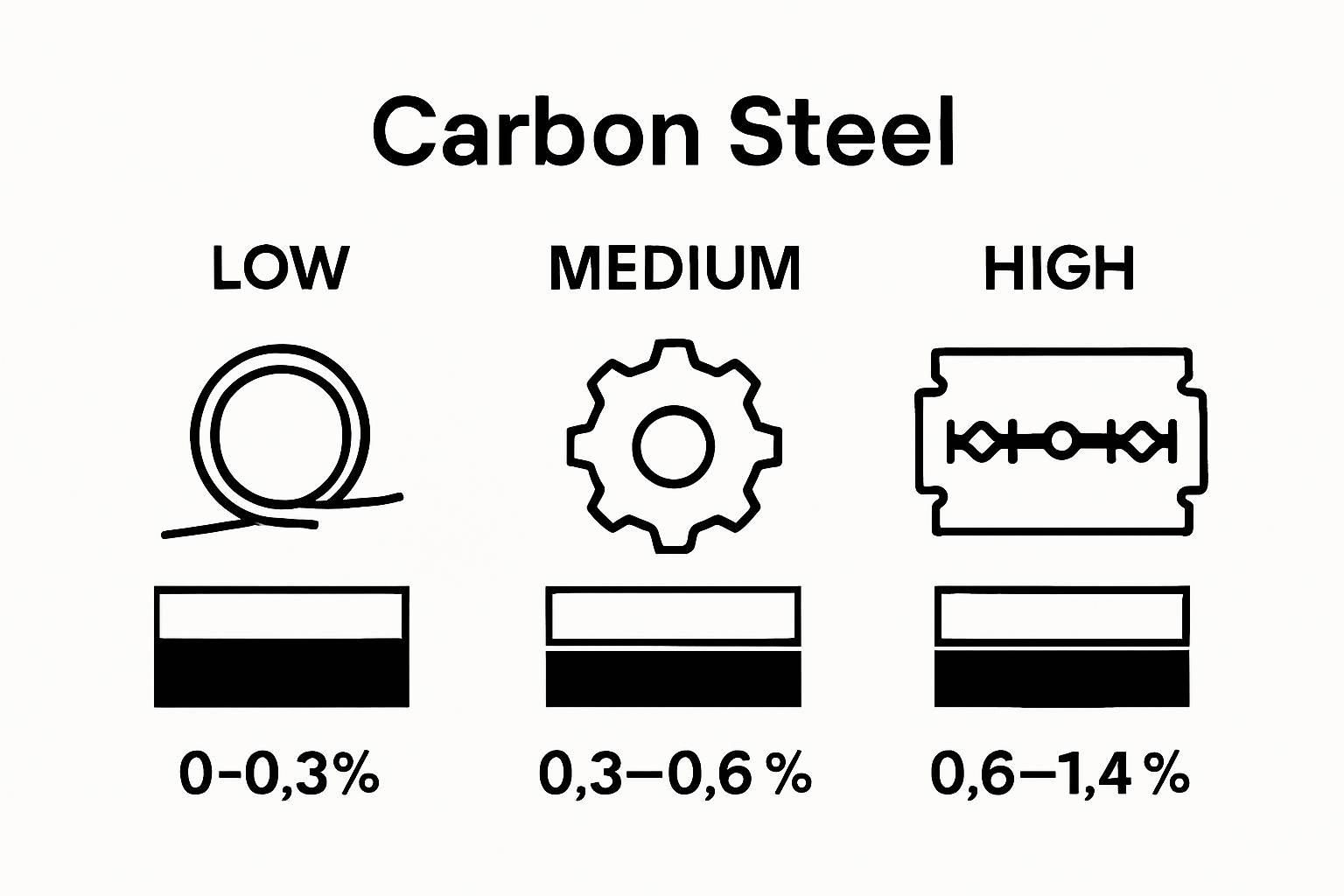
Carbon steels are typically classified into three primary categories based on their carbon concentration:
- Low Carbon Steel: Contains 0.05% to 0.25% carbon, offering excellent weldability and ductility
- Medium Carbon Steel: Ranges from 0.25% to 0.60% carbon, providing enhanced strength and wear resistance
- High Carbon Steel: Contains 0.60% to 2.0% carbon, delivering maximum hardness and rigidity
Each classification serves unique industrial purposes, from construction and infrastructure to precision engineering and manufacturing equipment.
Below is a comparative table summarising the three main types of carbon steel according to their carbon content, main properties, and typical industrial uses.
| Category | Carbon Content | Main Properties | Typical Industrial Uses |
|---|---|---|---|
| Low Carbon Steel | 0.05% to 0.25% | Excellent weldability, high ductility | Construction, automotive panels |
| Medium Carbon Steel | 0.25% to 0.60% | Enhanced strength, good wear resistance | Machinery parts, railway tracks |
| High Carbon Steel | 0.60% to 2.0% | Maximum hardness, high rigidity | Cutting tools, springs, wires |
 Read more about our industrial carbon steel applications to understand how these material variations translate into practical solutions for complex engineering challenges.
Understanding carbon steel’s fundamental composition allows engineers, manufacturers, and designers to select the most appropriate material variant for specific project requirements, ensuring optimal performance, durability, and cost-effectiveness.
Importance of Carbon Steel in Industry
Global steel production remains critical to industrial development, with carbon steel standing at the forefront of material engineering. This versatile alloy plays an indispensable role across multiple sectors, driving technological advancement and economic progress through its unique material properties and adaptable nature.
Critical Industrial Applications
Carbon steel serves as a foundational material in numerous industrial domains, providing structural integrity and performance capabilities that are unmatched by alternative materials. Its widespread adoption stems from remarkable characteristics such as strength, durability, and cost-effectiveness. Industries ranging from construction and automotive manufacturing to energy infrastructure and machinery production rely extensively on carbon steel for critical components and structural elements.
Key industrial sectors leveraging carbon steel include:
- Construction and infrastructure development
- Automotive and transportation manufacturing
- Energy and power generation systems
- Heavy machinery and equipment fabrication
- Agricultural and mining equipment production
Economic and Performance Advantages
The economic significance of carbon steel extends beyond its immediate material properties. Manufacturers and engineers appreciate carbon steel for its ability to be precisely engineered to meet specific performance requirements. By adjusting carbon content and incorporating targeted alloying elements, industries can create materials with tailored mechanical characteristics such as increased hardness, improved tensile strength, and enhanced corrosion resistance.
Performance characteristics that make carbon steel invaluable:
- Exceptional strength-to-weight ratio
- Remarkable thermal and electrical conductivity
Discover more about our advanced steel manufacturing processes and explore how carbon steel continues to drive industrial innovation.
Carbon steel represents more than just a material choice. It embodies the intersection of engineering precision, economic efficiency, and technological advancement, enabling industries to push boundaries and create increasingly sophisticated solutions for complex global challenges.
Key Properties That Make Carbon Steel Valuable
Carbon steel emerges as an exceptional engineering material due to its remarkable combination of mechanical and physical properties. Scientific research in materials engineering reveals the nuanced characteristics that position carbon steel as a cornerstone material across diverse industrial applications.
Mechanical Performance Characteristics
The intrinsic value of carbon steel stems from its extraordinary mechanical properties. Unlike many alternative materials, carbon steel offers a sophisticated balance between strength, ductility, and machinability. Engineers can manipulate its carbon content to achieve precise performance specifications, making it an incredibly versatile material for complex industrial requirements.
Key mechanical advantages include:
- High tensile strength
- Superior impact resistance
- Excellent formability
- Consistent structural integrity
- Remarkable load-bearing capabilities
Thermal and Chemical Resilience
Beyond mechanical performance, carbon steel demonstrates exceptional thermal stability and chemical resistance. Its molecular structure allows it to maintain structural integrity under extreme temperature variations and challenging environmental conditions. This resilience makes carbon steel particularly valuable in sectors requiring materials that can withstand intense operational stress.
Significant thermal and chemical properties encompass:
- Wide temperature performance range
- Resistance to thermal deformation
- Minimal chemical reactivity
- Enhanced corrosion resistance through proper treatment
Explore advanced carbon steel properties for modern industrial applications to understand how these characteristics translate into real-world engineering solutions.
Ultimately, carbon steel represents more than a simple metal alloy. It embodies a sophisticated material science breakthrough, offering engineers and manufacturers a robust, adaptable solution that continues to drive technological innovation across multiple industrial sectors.
Practical Applications of Carbon Steel in Different Sectors
Industrial versatility defines carbon steel as a material that transcends traditional engineering boundaries, delivering exceptional performance across multiple critical sectors. Its adaptable nature enables manufacturers and engineers to leverage its unique properties for increasingly sophisticated industrial solutions.
Construction and Infrastructure Development
Carbon steel forms the backbone of modern infrastructure, providing structural integrity for buildings, bridges, highways, and massive engineering projects. Its superior strength-to-weight ratio makes it an ideal material for constructing robust frameworks that can withstand significant environmental stresses. Architects and civil engineers rely on carbon steel’s consistent performance to create safe, long-lasting structures that form the foundation of urban and industrial landscapes.
Key construction applications include:
- High-rise building frameworks
- Bridge support structures
- Road and railway infrastructure
- Industrial plant construction
- Large-scale architectural installations
Manufacturing and Industrial Equipment
Manufacturing sectors leverage carbon steel’s exceptional mechanical properties to develop complex machinery, precision tools, and heavy-duty equipment. Its ability to be precisely machined and heat-treated allows engineers to create components with specific performance characteristics. From automotive manufacturing to agricultural machinery, carbon steel remains an indispensable material that drives technological innovation.
Primary manufacturing domains utilizing carbon steel include:
- Automotive component fabrication
- Machine tool production
- Agricultural equipment manufacturing
- Mining and extraction machinery
- Industrial processing equipment
Discover how our advanced carbon steel solutions support industrial innovation and explore the transformative potential of this remarkable material.
Carbon steel represents more than a simple engineering material. It embodies the intersection of scientific innovation, industrial capability, and technological advancement, enabling industries to push boundaries and create increasingly sophisticated solutions for complex global challenges.
Environmental and Economic Benefits of Using Carbon Steel
Global steel production standards demonstrate that carbon steel represents more than a mere industrial material. It embodies a sophisticated solution balancing economic efficiency, environmental sustainability, and technological innovation.
Sustainability and Recycling Potential
Carbon steel stands out as an environmentally responsible material with unprecedented recyclability. Unlike many alternative materials that degrade during reprocessing, steel maintains its fundamental mechanical properties through multiple recycling cycles. This unique characteristic enables industries to significantly reduce raw material consumption, minimize waste generation, and lower overall environmental impact.
Key environmental advantages include:
- Near 100% recyclability
- Reduced carbon footprint compared to alternative materials
- Minimal energy requirements for reprocessing
- Extended material lifecycle
- Preservation of material integrity during recycling
Economic Efficiency and Cost Effectiveness
Beyond environmental benefits, carbon steel delivers remarkable economic advantages for manufacturers and industries. Its relatively low production costs, combined with exceptional durability and performance, make it an attractive material for large-scale industrial applications. The ability to precisely engineer carbon steel properties allows businesses to optimize material usage while maintaining high-performance standards.
Significant economic benefits encompass:
- Lower initial material procurement costs
- Reduced long-term maintenance expenses
- Enhanced product longevity
- Simplified manufacturing processes
- Consistent performance across diverse applications
Learn more about our sustainable steel recycling practices and discover how innovative approaches are transforming industrial material management.
Carbon steel represents a holistic solution that transcends traditional material considerations.
 By integrating environmental consciousness with economic pragmatism, it continues to drive sustainable industrial development and technological progress.
The following table highlights the key environmental and economic benefits of using carbon steel, allowing for a quick reference to understand its holistic value across industries.
| Benefit Type | Key Advantage | Brief Description |
|---|---|---|
| Environmental | Near 100% recyclability | Carbon steel can be recycled repeatedly without property loss |
| Environmental | Lower carbon footprint | Produces less environmental impact compared to alternatives |
| Environmental | Minimal energy required for recycling | Recycling carbon steel is energy-efficient |
| Economic | Lower initial material costs | Affordable compared to other structural materials |
| Economic | Reduced long-term maintenance expenses | Durable and needs fewer replacements over time |
| Economic | Enhanced product longevity | Long service life in industrial applications |
Experience the True Value of Carbon Steel with Genesis Steel
Struggling to find carbon steel solutions that truly meet your project requirements? You have just read about the mechanical strength, durability, and versatility of carbon steel materials. Now, it is time to turn this knowledge into real-world results. At Genesis Steel, our extensive stock of premium hot-rolled steel sheets and steel plates ensures you never have to compromise on quality or efficiency. Our expert team is ready to help you overcome challenges related to material performance, reliability, and consistency.
Choose a partner that delivers more than just steel. Discover our comprehensive carbon steel range and expert service for your next project. Contact Genesis Steel today and give your business the proven advantages of industry-leading carbon steel solutions. Act now to secure supply and enjoy the benefit of fast, professional support – visit Genesis Steel to get started.
Frequently Asked Questions
What is carbon steel and how is it different from other types of steel?
Carbon steel is an alloy primarily composed of iron and carbon, with carbon content ranging from 0.05% to 2.0%. Unlike other types of steel, carbon steel’s properties, such as strength and ductility, are significantly influenced by its carbon content.
What are the advantages of using carbon steel in construction?
Carbon steel offers exceptional strength-to-weight ratio, durability, and cost-effectiveness, making it ideal for construction applications such as frameworks for buildings and bridges. Its ability to withstand significant environmental stress further enhances its value in infrastructure development.
How does carbon content affect the properties of carbon steel?
As the carbon content in carbon steel increases, the steel becomes harder and stronger but also less ductile. This variation allows manufacturers to tailor the mechanical properties of carbon steel for specific industrial applications.
What industries benefit the most from carbon steel?
Carbon steel is widely utilized across various industries, including construction, automotive manufacturing, energy, and machinery production due to its mechanical strength, durability, and adaptability to different engineering needs.