

Steel parts do not just rely on raw strength. How their surfaces are finished can mean the difference between parts that last for decades and ones that fail within a year. Here is something wild. Research from the University of Pretoria shows that precise surface treatments can reduce steel degradation by up to 40 percent. Sounds like just a pretty polish, right? It is actually a powerful barrier that determines performance, durability and even the money spent on repairs. The science behind these finishes might surprise you.
Table of Contents
- Defining Steel Surface Finishes: What They Are
- The Importance of Steel Surface Finishes in Industry
- How Steel Surface Finishes Affect Performance and Longevity
- Types of Steel Surface Finishes: An Overview
- Choosing the Right Steel Surface Finish for Your Project
Quick Summary
| Takeaway | Explanation |
|---|---|
| Surface finishes enhance steel performance. | Proper surface treatments improve durability, corrosion resistance, and mechanical properties, essential for industrial applications. |
| Choose finishes based on specific needs. | Selecting the right surface finish requires evaluating factors like environmental exposure and mechanical stress for optimal performance. |
| Surface treatments reduce maintenance costs. | Efficient surface modifications can significantly extend lifespan and reduce the frequency of repairs. |
| Different finishes cater to unique applications. | Techniques such as chemical or mechanical treatments provide tailored benefits for specific industrial environments, from mining to pharmaceuticals. |
| Strategically match finishes to project requirements. | A thoughtful approach in matching surface finishes to project demands enhances reliability, productivity, and overall material performance. |
Defining Steel Surface Finishes: What They Are
Steel surface finishes represent the final visual and functional treatment applied to steel components that dramatically influence their performance, durability, and aesthetic qualities. These specialized treatments transform raw steel surfaces by modifying their texture, appearance, and protective characteristics to meet specific industrial requirements.
The Fundamental Purpose of Surface Finishes
At their core, steel surface finishes serve multiple critical functions beyond mere appearance. They protect steel from environmental degradation, enhance corrosion resistance, improve mechanical properties, and prepare materials for subsequent manufacturing processes. Understanding how steel is made provides crucial context for appreciating the complexity of these surface treatments.
Key objectives of steel surface finishes include:
- Preventing rust and oxidation
- Improving adhesion for paints and coatings
- Enhancing mechanical performance
- Reducing friction between moving components
- Creating specific aesthetic or functional textures
Technical Characteristics and Industrial Significance
According to the Hot Dip Galvanizers Association of Southern Africa, surface finishes are not cosmetic additions but strategic engineering interventions. Each finish involves precise metallurgical processes that modify the steel’s outermost layer, transforming its interaction with environmental and mechanical stresses.
Industrial applications demand surface finishes that can withstand extreme conditions such as high temperatures, chemical exposure, mechanical abrasion, and varying atmospheric conditions. The right surface finish can extend a steel component’s operational lifespan, reduce maintenance costs, and ensure consistent performance across challenging environments.
Professional engineers and manufacturers select surface finishes based on comprehensive assessments of material requirements, operational conditions, and specific performance expectations. This meticulous selection process ensures that steel components deliver optimal functionality and reliability in their intended applications.
The Importance of Steel Surface Finishes in Industry
Steel surface finishes represent a critical technological intervention that transforms industrial performance, reliability, and longevity across multiple sectors. These specialized treatments go far beyond aesthetic modifications, serving as fundamental engineering solutions that address complex material challenges in demanding industrial environments.
Performance Enhancement and Protection Mechanisms
Industrial applications require steel components to withstand extreme operational conditions. Surface finishes provide a strategic defense mechanism against environmental degradation, mechanical stress, and chemical interactions. What is heat treated steel offers additional context for understanding how surface treatments contribute to material resilience.
Key performance enhancement aspects include:
- Creating barrier protection against corrosion
- Improving wear resistance
- Reducing friction between mechanical components
- Enhancing thermal stability
- Optimizing electrical conductivity
Economic and Technical Implications
According to research from the University of Pretoria, surface treatments significantly impact material properties, directly influencing industrial efficiency and cost-effectiveness. Precise surface modifications can extend equipment lifecycle, reduce maintenance expenses, and improve overall operational reliability.
Manufacturers and engineers strategically select surface finishes based on comprehensive assessments of environmental conditions, mechanical requirements, and specific performance expectations. This nuanced approach ensures that steel components deliver consistent, reliable performance across diverse industrial applications, from mining and construction to precision engineering and heavy manufacturing.
The technological sophistication of modern surface finishing techniques represents a critical intersection between materials science and industrial engineering, demonstrating how advanced treatments can fundamentally transform steel’s fundamental characteristics and performance potential.
How Steel Surface Finishes Affect Performance and Longevity
Steel surface finishes are sophisticated engineering interventions that fundamentally transform material performance, durability, and operational capabilities. These specialized treatments represent a complex interaction between metallurgical science and industrial requirements, strategically modifying steel’s outermost layer to enhance its inherent properties.
Mechanisms of Performance Enhancement
Surface finishes operate through intricate mechanisms that modify steel’s interaction with environmental and mechanical stresses. By altering the material’s microscopic topography, these treatments create protective barriers that mitigate degradation processes. Carbon Steel Properties for Gauteng Industries 2025 provides additional insights into how surface modifications impact material characteristics.
Critical performance transformation mechanisms include:
- Reducing surface energy and reactivity
- Creating multi-layered protective coatings
- Modifying molecular bonding structures
- Enhancing mechanical load distribution
- Minimizing potential corrosion initiation points
Quantifiable Impact on Industrial Applications
According to research from the University of Pretoria, surface treatments can dramatically extend steel component lifecycles. The study demonstrated that precision surface modifications can reduce material degradation by up to 40%, significantly improving operational reliability and reducing maintenance costs.
Industrial environments impose extreme challenges on material performance, ranging from high-temperature stress to corrosive chemical exposures. Surface finishes act as sophisticated protective interfaces, transforming standard steel into high-performance materials capable of withstanding punishing operational conditions. By strategically engineering the steel’s surface, manufacturers can create components that maintain structural integrity, resist environmental challenges, and deliver consistent performance across demanding industrial sectors.
Types of Steel Surface Finishes: An Overview
Steel surface finishes represent a sophisticated spectrum of technological interventions, each designed to address specific industrial performance requirements. These treatments transform steel’s fundamental characteristics through precise engineering techniques that modify material properties at the microscopic level.
Primary Surface Finish Categories
Industrial applications demand diverse surface finish strategies, each tailored to unique operational challenges. What is heat treated steel provides context for understanding how thermal processes contribute to surface modification techniques.
Comprehensive surface finish categories include:
Below is a comparison table outlining the main categories of steel surface finishes, describing each type and summarising their core functions in industrial applications.
| Surface Finish Category | Description | Primary Function in Industry |
|---|---|---|
| Mechanical Finishes | Physical alteration of surface by grinding, polishing, or blasting | Reduces roughness and improves friction |
| Chemical Treatments | Application of chemicals to create protective layers | Enhances corrosion resistance |
| Electroplated Coatings | Deposition of metal layers via electrochemical process | Adds new properties and restores surfaces |
| Thermal Spray Coatings | Spraying melted materials onto the steel surface | Increases wear and thermal resistance |
| Conversion Coatings | Chemical conversion of surface layer into protective compound | Strengthens barrier against degradation |
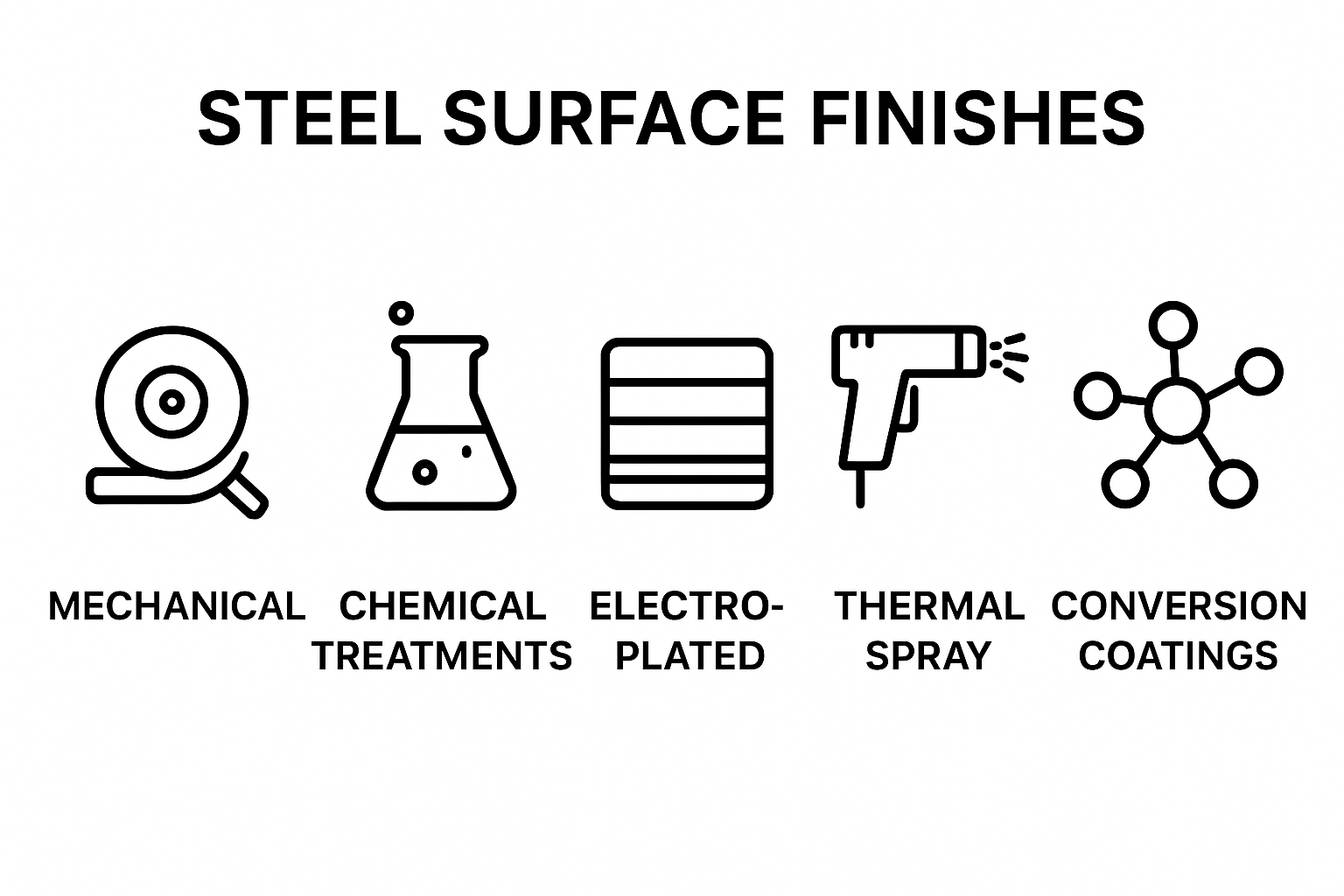
- Mechanical Finishes
- Chemical Treatments
- Electroplated Coatings
- Thermal Spray Coatings
- Conversion Coatings
Technical Characteristics and Performance Implications
According to research from the University of Pretoria, different surface finish techniques produce dramatically varied material properties. Mechanical finishes like grinding and polishing alter surface topography, reducing roughness and improving friction characteristics. Chemical treatments create protective molecular layers that enhance corrosion resistance, while electroplated coatings introduce entirely new material properties through precision metallic deposition.
Each surface finish technique offers unique advantages, enabling engineers to strategically select treatments based on specific performance requirements. Thermal spray coatings, for instance, can dramatically improve wear resistance and thermal stability, making them ideal for high-stress industrial environments. Conversion coatings provide microscopically thin protective layers that transform steel’s surface chemistry, creating robust barriers against environmental degradation.
Choosing the Right Steel Surface Finish for Your Project
Selecting the appropriate steel surface finish represents a critical engineering decision that directly impacts a project’s performance, durability, and long-term reliability. This complex process requires a comprehensive understanding of material properties, operational environments, and specific performance requirements.
The table below summarises key considerations for selecting an appropriate steel surface finish, helping decision-makers weigh up technical and practical requirements when planning industrial projects.
| Selection Factor | Relevance to Surface Finish Choice |
|---|---|
| Environmental Exposure | Determines need for corrosion or chemical resistance |
| Mechanical Stress Levels | Guides toughness and wear resistance requirements |
| Required Corrosion Resistance | Influences type and thickness of protective finish |
| Budget Constraints | Affects extent of finish sophistication and overall approach |
| Operational Temperature Range | Identifies need for thermal stability in harsh conditions |
| Expected Component Lifespan | Helps justify investment in higher-performing finishes |
Critical Selection Considerations
Engineers and project managers must evaluate multiple factors when determining the most suitable surface finish. Types of Steel Plates for Gauteng Industry 2025 provides contextual insights into material selection strategies that complement surface finish considerations.
Key evaluation parameters include:
- Anticipated environmental exposure
- Mechanical stress levels
- Required corrosion resistance
- Budget constraints
- Operational temperature range
- Expected component lifespan
Strategic Matching of Finish to Application
According to research from Stellenbosch University, precise surface finish selection demands a nuanced understanding of material interactions. Different industrial sectors require specific surface characteristics. Mining applications might prioritize extreme wear resistance, while pharmaceutical environments demand microscopically smooth surfaces that minimize particle contamination.
Successful surface finish selection involves a systematic approach that balances technical requirements with economic considerations. Engineers must assess the total lifecycle cost, understanding that an initially more expensive surface treatment can significantly reduce maintenance expenses and extend equipment operational reliability. By meticulously matching surface finish characteristics to specific project demands, manufacturers can optimize material performance, reduce potential failure points, and enhance overall industrial productivity.
Upgrade Your Steel Projects With Proven Surface Finish Solutions
Choosing the right steel surface finish can be daunting, especially when facing issues like corrosion, abrasion, or unpredictable service life across your industrial applications. If your operation depends on steel sheets or plates that stand up to demanding South African environments, understanding finish techniques is vital. Fortunately, you do not have to solve this alone. Explore our Uncategorised Archives for even more insights aligned with your specific finishing challenges.
Trust Genesis Steel for a comprehensive supply of hot-rolled steel sheets and plates, in grades and sizes tailored for your application. Our experienced team helps you match the perfect surface finish for your project needs, reducing downtime and ensuring longer-lasting performance. Visit Genesis Steel today for personalised advice and see how our fast, reliable service supports your goals. Do not delay if your business demands quality steel solutions that perform – reach out now and get the Genesis advantage.
Frequently Asked Questions
What are steel surface finishes?
Steel surface finishes are specialized treatments applied to steel components that enhance their performance, durability, and appearance. These finishes protect the steel from environmental damage, improve corrosion resistance, and modify the surface for better adhesion and mechanical performance.
Why are surface finishes important for industrial applications?
Surface finishes are crucial because they protect steel components from corrosion, wear, and mechanical stress, extending their operational lifespan and reducing maintenance costs. They help ensure reliable performance in demanding industrial environments.
What are the different types of steel surface finishes?
There are several types of steel surface finishes, including mechanical finishes, chemical treatments, electroplated coatings, thermal spray coatings, and conversion coatings. Each type addresses specific performance needs and environmental challenges.
How do I choose the right surface finish for my project?
Choosing the right surface finish involves evaluating factors such as anticipated environmental exposure, mechanical stress levels, required corrosion resistance, budget constraints, and expected component lifespan. This process ensures that the selected finish meets both technical requirements and economic considerations.