
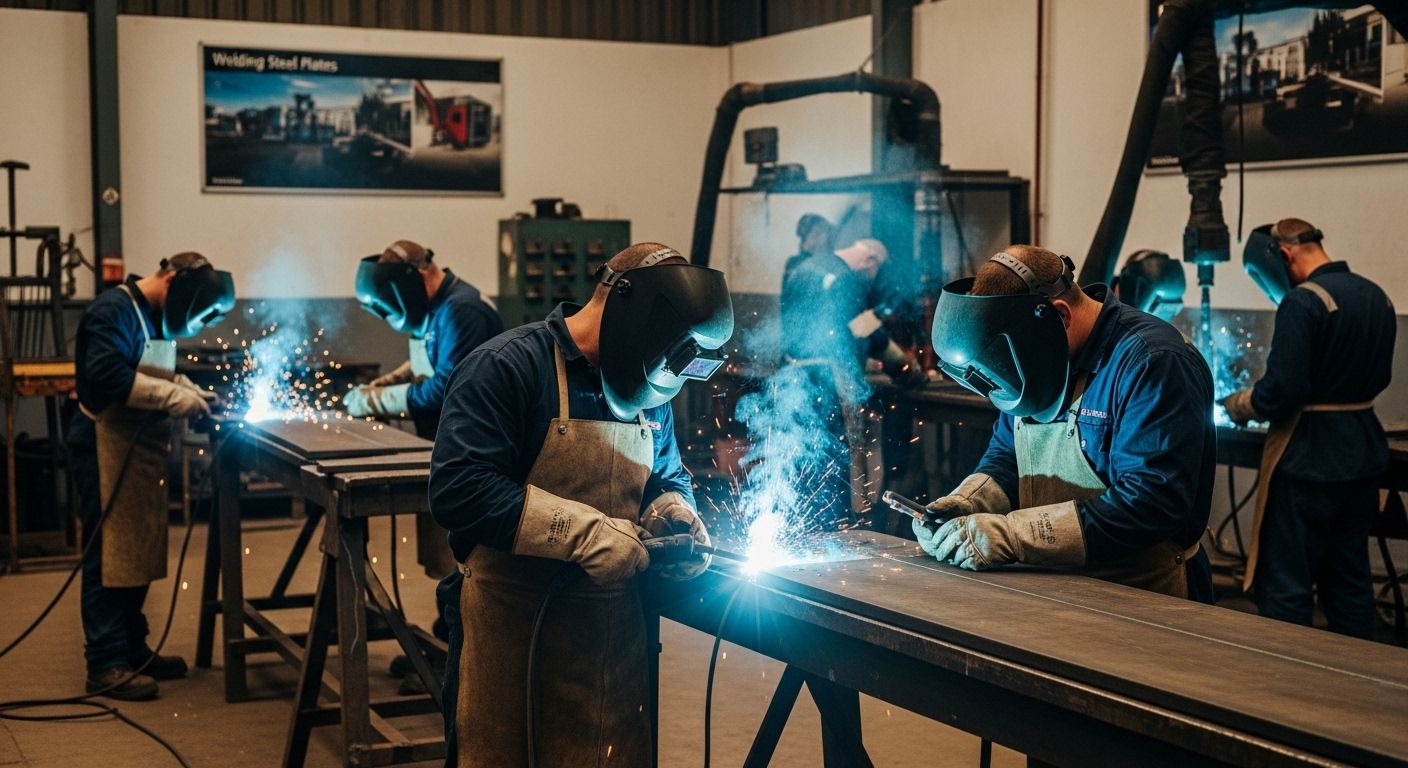
Welding steel plates in Gauteng is about more than just heat and sparks. Some projects in 2025 are seeing labour and overhead costs making up nearly 85 percent of total welding expenses. You might think the secret to a strong joint is all about technique, but it turns out that picking the right steel and understanding market dynamics can be the deciding factor for success.
Table of Contents
- Choosing Steel Plates For Industrial Welding
- Key Welding Methods For Strong Steel Joints
- Quality Control And Safety In Plate Welding
- Cost Factors And Sourcing In Gauteng For 2025
Quick Summary
| Takeaway | Explanation |
|---|---|
| Choose the right steel plates carefully | Selecting steel involves evaluating material properties like tensile and yield strength for optimal performance. |
| Prioritize advanced welding techniques | Methods such as electric resistance and friction welding offer specific advantages for different applications. |
| Implement a robust quality management system | Ensuring consistent welding standards through systematic process improvements reduces defects and failures. |
| Focus on comprehensive safety measures | Establish clear safety protocols to protect workers and minimize hazards during welding operations. |
| Understand cost dynamics for sourcing | Familiarize with cost factors to make informed procurement decisions in the Gauteng steel market for 2025. |
Choosing Steel Plates for Industrial Welding
Selecting the right steel plates for industrial welding requires a strategic approach that balances material properties, application requirements, and performance expectations. The process demands careful consideration of multiple technical factors that directly impact the structural integrity and longevity of welded components.
Material Composition and Mechanical Properties
Industrial welding demands steel plates with specific mechanical characteristics that can withstand extreme operational conditions. Research from the National Academies Press highlights the critical importance of understanding toughness requirements in the heat-affected zones of welded structural steels. Engineers must evaluate key parameters such as:
- Tensile Strength: Determines the plate’s resistance to breaking under tension
- Yield Strength: Indicates the stress at which material begins to deform plastically
- Elongation: Measures the material’s ductility and ability to deform without fracturing
Understanding these properties ensures optimal performance in high-stress industrial environments. A study published in ResearchGate demonstrates how different welding electrode types can significantly influence the tensile properties of low carbon steel, underscoring the complexity of material selection.
Structural Design Considerations
Beyond material composition, the structural design of welded steel plates plays a crucial role in industrial applications. Research in the journal Metals emphasizes the relationship between plate slenderness ratio and ultimate strength. Engineers must carefully analyze:
- Plate thickness and dimensional requirements
- Expected mechanical loads
- Environmental exposure conditions
- Potential thermal and mechanical stress factors
The slenderness ratio directly impacts the plate’s ability to maintain structural integrity under varying load conditions. This means selecting steel plates is not just about material strength but also about understanding how geometric characteristics interact with mechanical performance.
Welding Compatibility and Performance
Successful industrial welding depends on selecting steel plates that demonstrate excellent weldability. This involves evaluating chemical composition, preheating requirements, and post-weld heat treatment processes. Compatibility between the base metal and welding consumables determines the overall quality and reliability of the welded structure.
Key considerations include minimizing the risk of:
- Brittle fractures
- Hydrogen-induced cracking
- Reduced mechanical properties in the heat-affected zone
Professional fabricators must conduct thorough material testing and maintain stringent quality control measures to ensure the selected steel plates meet the demanding requirements of industrial welding applications.
Key Welding Methods for Strong Steel Joints
Industrial steel fabrication demands precision and expertise in selecting and executing appropriate welding methods. Different welding techniques offer unique advantages for creating robust and reliable steel joints, each tailored to specific project requirements and material characteristics.
Electric Resistance Welding Techniques
Electric resistance welding (ERW) represents a sophisticated approach to joining metal components by generating heat through electrical current. This method passes electric current through metal parts, creating precise and efficient joints with minimal environmental impact. ERW excels in manufacturing processes where consistent, clean welds are critical.
The technique proves particularly effective for thin material applications, offering several distinct advantages:
- Rapid Processing: Enables quick joint formation
- Low Pollution: Minimizes environmental contamination
- Precise Control: Allows sophisticated heat management
Manufacturers frequently utilize ERW in automotive body construction, steel pipe production, and intricate metal fabrication where dimensional accuracy is paramount. The method’s efficiency makes it a preferred choice for high-volume industrial applications requiring uniform joint quality.
Advanced Friction Welding Processes
Friction welding (FWR) emerges as an innovative solid-state welding technique that generates heat through mechanical friction between workpieces. Unlike traditional melting processes, friction welding creates strong joints without completely liquefying base materials, preserving their fundamental metallurgical properties.
This method offers remarkable benefits across multiple industrial sectors:
- Minimal Material Waste: Reduces material loss during joining
- Enhanced Mechanical Properties: Maintains original material strength
- Versatile Application: Suitable for metals and thermoplastics
Aerospace, automotive, and heavy machinery industries particularly appreciate friction welding for its ability to produce high-integrity joints with superior mechanical characteristics. The process allows engineers to join dissimilar materials that would be challenging with conventional welding techniques.
Electroslag Welding for Thick Materials
Electroslag welding (ESW) represents a specialized technique designed for joining exceptionally thick steel plates and sections. This single-pass welding process excels in vertical or near-vertical positioning, handling material thicknesses ranging from 25mm to approximately 300mm.
ESW distinguishes itself through several key characteristics:
- High Productivity: Completes complex welds efficiently
- Deep Penetration: Manages extremely thick material joins
- Consistent Quality: Provides uniform weld integrity
Typically utilizing direct current with voltage ranges between 40-50V and currents around 600A, electroslag welding is instrumental in constructing heavy industrial structures, large-scale machinery, and critical infrastructure components where joint strength is non-negotiable.
Professional welders must carefully select the appropriate method based on material specifications, project requirements, and desired joint characteristics. Each welding technique offers unique advantages, and mastering their application ensures robust, reliable steel joints that meet stringent industrial standards.
To help readers understand the range of welding methods discussed and their respective features, the table below compares the main methods for welding steel plates in industrial settings as described in the article.
| Welding Method | Key Features | Typical Applications |
|---|---|---|
| Electric Resistance Welding (ERW) | Rapid, low pollution, precise | Automotive, pipe manufacturing, thin metals |
| Friction Welding (FWR) | Minimal waste, strong joints, versatile | Aerospace, automotive, joining dissimilar metals |
| Electroslag Welding (ESW) | High productivity, deep penetration, consistent quality | Thick plates, heavy industry, infrastructure |
Quality Control and Safety in Plate Welding
Ensuring quality and safety in plate welding represents a critical aspect of industrial manufacturing that directly impacts structural integrity, operational reliability, and worker protection. Professional welding operations demand comprehensive quality management strategies that go beyond simple inspection protocols.
Comprehensive Quality Management System
Research from structural engineering experts highlights that effective quality control emerges from systematic process improvements rather than reactive inspection methods. A robust Quality Management System (QMS) becomes fundamental in maintaining consistent welding standards.
Key elements of an effective QMS include:
- Process Documentation: Detailed procedures for each welding technique
- Material Traceability: Complete records of steel plate origins and characteristics
- Continuous Training: Regular skill enhancement for welding personnel
- Performance Metrics: Quantifiable quality benchmarks
Implementing such a system ensures that potential defects are prevented rather than merely detected. This proactive approach minimizes risks associated with structural failures and maintains high manufacturing standards.
Welder Qualification and Skill Verification
Advanced metallurgical research emphasizes the critical role of welder qualification in achieving high-quality welded joints. Professional certification goes beyond basic technical skills, encompassing comprehensive understanding of material properties, welding techniques, and safety protocols.
Effective welder qualification programs typically involve:
- Practical Skill Assessments: Hands-on performance evaluations
- Theoretical Knowledge Tests: Understanding metallurgical principles
- Non-Destructive Testing (NDT): Verifying weld quality through advanced techniques
- Periodic Recertification: Ensuring continued competence
These rigorous verification processes guarantee that only skilled professionals handle complex welding tasks, significantly reducing the probability of structural defects.
Safety Protocols and Risk Mitigation
Safety represents a paramount concern in plate welding operations. Comprehensive safety protocols protect both workers and infrastructure by systematically identifying and mitigating potential hazards.
Critical safety considerations include:
- Personal Protective Equipment (PPE): Specialized gear for thermal and chemical protection
- Workspace Ventilation: Managing potentially harmful fume emissions
- Equipment Maintenance: Regular inspection of welding tools and protective systems
- Emergency Response Planning: Predefined procedures for potential accidents
Professional welding teams must develop a safety culture that prioritizes worker protection while maintaining operational efficiency. This approach involves continuous training, risk assessment, and implementation of state-of-the-art safety technologies.
Successful quality control and safety management in plate welding require an integrated approach that combines technical expertise, systematic processes, and a commitment to continuous improvement. By implementing comprehensive quality management systems, maintaining high welder skill standards, and prioritizing safety, industrial organizations can achieve exceptional welding performance while protecting their most valuable assets – their personnel and infrastructure.
Cost Factors and Sourcing in Gauteng for 2025
Navigating the steel fabrication and welding market in Gauteng requires a comprehensive understanding of the complex cost dynamics that will shape industrial procurement strategies in 2025. Strategic sourcing demands a nuanced approach that balances technical requirements, budgetary constraints, and long-term project sustainability.
Structural Pricing and Market Dynamics
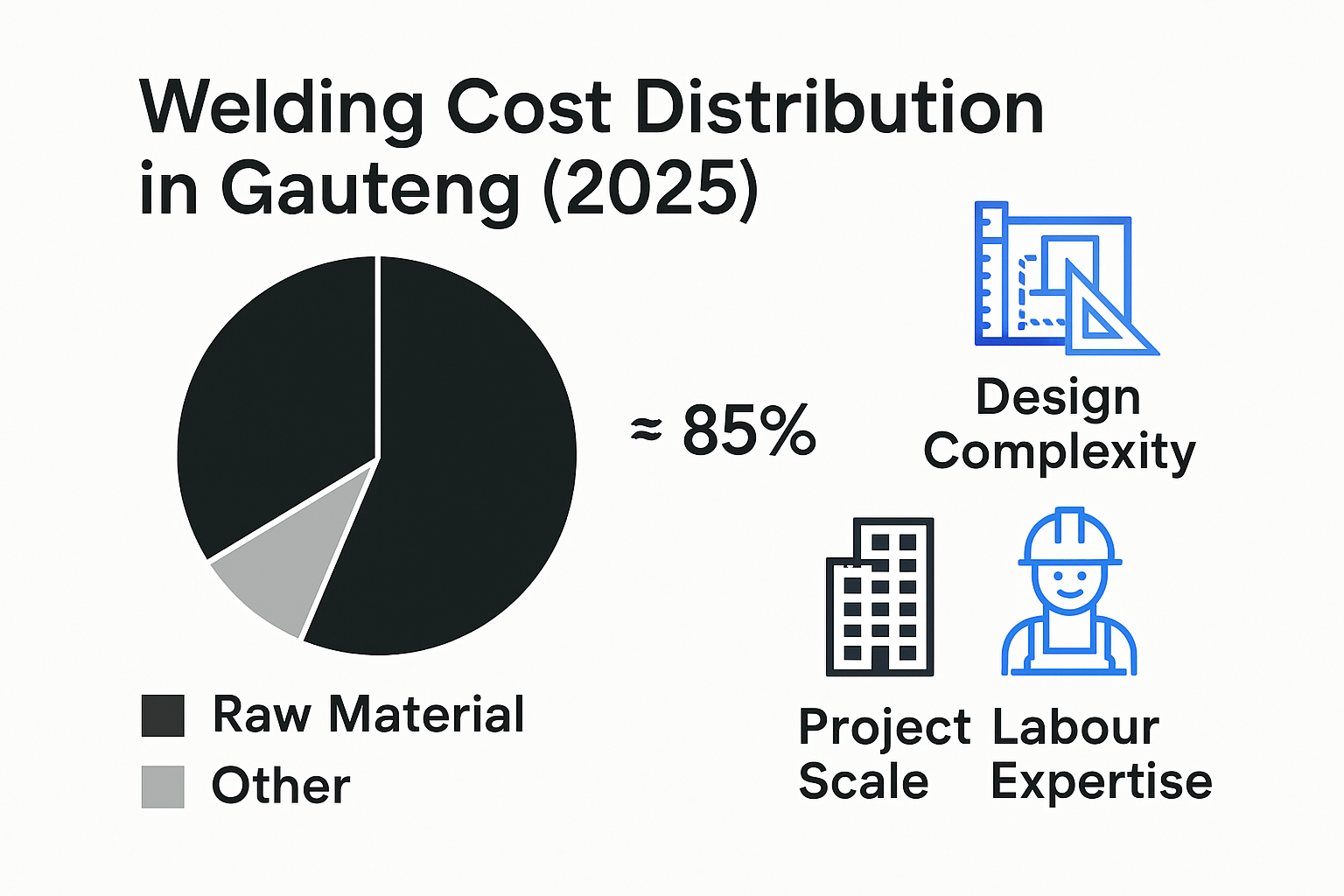
Research on steel fabrication costs reveals intricate pricing structures that industrial buyers must carefully evaluate. In 2025, the Gauteng steel market presents a landscape of variable pricing influenced by multiple interconnected factors.
Key pricing components include:
- Raw Material Costs: Fluctuating global steel prices
- Design Complexity: Impact of intricate fabrication requirements
- Project Scale: Economies of scale considerations
- Labour Expertise: Skilled welding personnel premiums
Typical price ranges for fabricated steel products demonstrate significant variation:
For those budgeting or sourcing in Gauteng, this table summarises key cost ranges and what affects pricing for different steel fabrication and installation services in 2025.
| Service/Component | Typical Price Range (ZAR) | Influencing Factors |
|---|---|---|
| Fabricated Steel | R18,000 – R26,000/ton | Global steel prices, project scale, complexity |
| Structural Staircases | R4,500 – R9,000/m² | Design complexity, material, scale |
| Handrails & Balustrades | R950 – R2,200/m | Material, design, length |
| Erection & Installation | R4,000 – R8,000/ton | Labour rates, project logistics |
- Fabricated steel: R18,000 – R26,000 per ton
- Structural staircases: R4,500 – R9,000 per square meter
- Handrails and balustrades: R950 – R2,200 per linear meter
- Erection and installation: R4,000 – R8,000 per ton
Labor and Operational Expense Analysis
Detailed welding sector research provides critical insights into cost composition. Surprisingly, labor and overhead expenses dominate the financial landscape, representing approximately 85% of total welding project costs.
Cost optimization strategies focus on:
- Operator Efficiency: Reducing variability in welding processes
- Technique Selection: Choosing cost-effective welding methods
- Power Consumption: Minimizing energy-related expenses
- Material Utilization: Improving deposition efficiency
Interesting alternatives emerge for cost-conscious projects. Bolted joints can potentially offer cost savings between 6-20% compared to traditional welded connections, presenting an attractive option for large-scale industrial applications.
Strategic Sourcing Recommendations
Successful procurement in the Gauteng steel market requires a multifaceted approach. Industrial buyers must move beyond simple price comparisons and consider comprehensive value propositions.
Key recommendations include:
- Early Engagement: Collaborate with fabricators during initial planning stages
- Standardization: Utilize standard steel profiles to reduce custom fabrication costs
- Design Optimization: Minimize late-stage design modifications
- Bulk Purchasing: Leverage volume discounts for multi-project or phased implementations
Transparency remains crucial. Reputable suppliers in the Gauteng region prioritize clear pricing structures, demonstrating commitment to both cost-effectiveness and quality standards.
The 2025 steel fabrication landscape demands sophisticated strategies that balance technical requirements, financial constraints, and long-term project sustainability. Successful industrial buyers will distinguish themselves through nuanced understanding of market dynamics, strategic sourcing approaches, and a holistic view of project economics.
Frequently Asked Questions
What factors should I consider when choosing steel plates for welding?
Selecting steel plates requires evaluating their material composition, mechanical properties, and welding compatibility. Key parameters include tensile strength, yield strength, and elongation to ensure optimal performance in high-stress environments.
What are the key welding methods for steel plates in Gauteng?
The primary welding methods include Electric Resistance Welding (ERW), Friction Welding (FRW), and Electroslag Welding (ESW). Each method has unique advantages, such as ERW’s speed and precision, FRW’s minimal waste, and ESW’s capability to join thick materials effectively.
How can I ensure quality control in welding steel plates?
Implementing a comprehensive Quality Management System (QMS) is crucial. This includes process documentation, material traceability, continuous training for welders, and setting performance metrics to monitor welding standards and minimize defects.
What are the main cost factors involved in welding steel plates in Gauteng for 2025?
Cost factors include raw material prices, design complexity, labor expertise, and project scale. In Gauteng, labor and operational expenses comprise approximately 85% of total welding costs, making strategic sourcing and cost optimization essential.
Ready For Stronger, More Cost-Effective Steel Plate Welding in 2025?
Are you struggling with high labour costs or unpredictable steel plate supply in Gauteng, as highlighted in our recent article? When welding projects depend on quality steel plates and tight deadlines, you need a partner who understands both the technical details and the realities of the local market. At Genesis Steel, we help you solve these challenges by offering an extensive range of hot-rolled steel sheets and steel plates in various grades, along with quick service and expert support. Our dedicated team is committed to helping you meet the exacting demands of every welded structure and project phase. You do not have to compromise on material quality or availability while racing to meet your schedules.
Elevate your plate welding results for 2025 by choosing a stockist that aligns with industrial best practices. Browse our selection of steel sheets and steel plates or contact our Vulcania, Brakpan warehouse team today. Secure your supply now to reduce project risks and avoid costly delays. Visit Genesis Steel for reliable steel solutions tailored to your welding needs.